
To Treat or Not to Treat


In the last ten years or so positive reinforcement training has become very popular in the horse
world. Some people feel it is the only ethical way to train a horse. Others vehemently oppose it. And some walk a middle ground where they use it R+ in tandem with other training methods. R+ is most commonly seen in the liberty and trick training world, though you do find people who use it for all the riding and training they do. There are different variations of R+, some people use clickers, others use a target, but the common factor in the majority of R+ horse training is using treats to train the horse.
Positive reinforcement training stems from the idea of operant conditioning, a learning theory introduced by psychologist B.F. Skinner in the 1930's. Skinner believed behavior is influenced by its consequences (whether positive or negative). There are four "quadrants" of operant conditioning: positive reinforcement, negative reinforcement, positive punishment, and negative punishment. You can think of a reinforcement as a consequence that strengthens a desired behavior, which makes it more likely to be repeated in the future. You can think of punishment in this instance as a consequence that weakens a behavior which makes it less likely to happen in the future. Remember these are scientific terms, so don't get tripped up on the use of the words negative or punishment.
Skinner's original experiment was with rats, but the findings from his study have been applied in many different ways. There are applications for humans, especially teaching children. The learning theory has also been adapted for training various animals, dogs, dolphins, horses, and more. So let's get into some real life examples of each of the four quadrants as they apply to horse training.
Negative reinforcement is the scientific term for what horse people typically call pressure and release. For example, I ask my horse to sidepass and put pressure with my leg, when my horse takes a step, I release the pressure with my leg. This is actually one of my principles, that horse's learn by the release of pressure. It's a tried and true training method that can be applied in teaching many different things on the ground and in the saddle.
Positive reinforcement is when you add something rewarding to the situation to praise the horse for doing the right thing. Food is the most commonly thought of positive reinforcer but it is not the only one! You can also add a verbal reward to your horse through blowing or praising them in a positive tone of voice. Stroking or petting them can be a more tactile form of reward.
Positive punishment is adding an unpleasant stimulus to decrease a behavior. So what can this look like for horse training? Well positive punishment might come into play if a horse is behaving in a way that is dangerous. Let's say a horse is being aggressive, kicking and striking out at you. You may add pressure with say a whip to move the horse off you and get them to stop. Of course I'm not talking about abusing them in any way, but if you have a horse that is behaving in an aggressive or unsafe manner you may have to set a strong boundary to keep yourself safe.
Negative punishment is the only quadrant that doesn't apply well to horse training. This is where something is taken away that the person or animal desires right after a certain behavior occurs in order to decrease the occurrence of the behavior. An example might be a teenager losing privileges to play their video games because they didn't finish their chores. You can't really use this with a horse, as it's beyond their reasoning capabilties. I've seen people try to use negative punishment with a horse, say refusing to feed their horse because they had a bad ride. But the horse has no understanding of the correlation between these two, so it's not only ineffective, its also unfair to them.
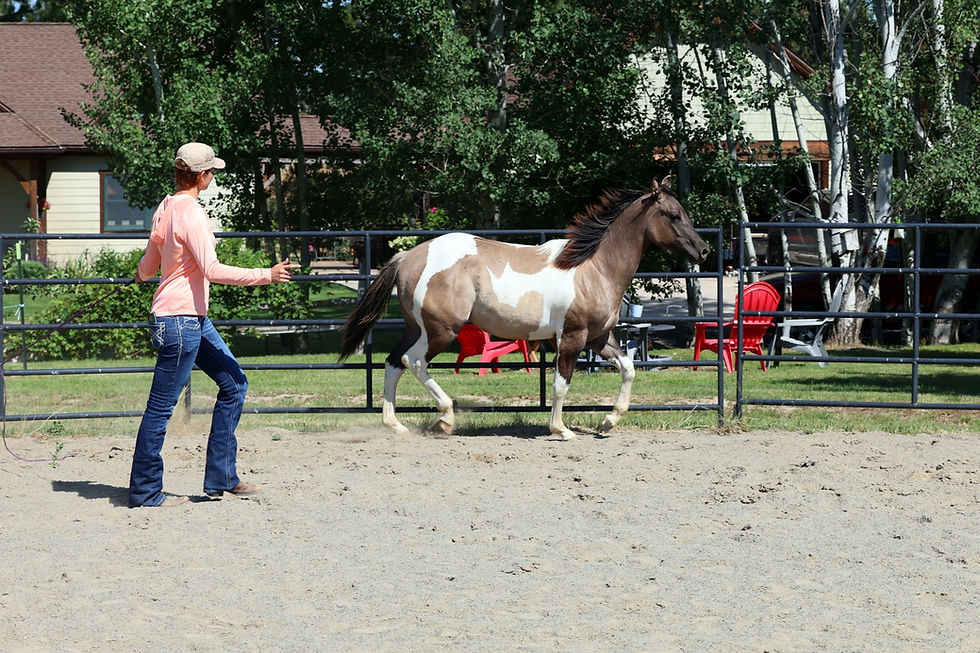
Positive reinforcement actually builds very well off of negative reinforcement. When you first start working with a horse, particularly one who hasn't been handled much (like a baby or a mustang) they will instinctively understand pressure and release as it is a concept that they use in communicating with other horses. It may take a horse a little while to accept positive reinforcement as an additional reward. I had a mustang in training recently that felt a sense of pressure anytime I touched her. So petting her in the beginning wasn't much of a reward, it actually added stress. Even blowing was difficult for her to understand. Simply taking the pressure off and leaving her alone was the only reward she could accept.
Now that we have a better understanding of the four quadrants and how they can work in horse training, let's ask the big question: Should you utilize treat training with your horse? As we already addressed, positive reinforcement is not specifically tied to a food reward, though that's what most people think of and use. So is it effective? I would say it depends on what your goals are.
I usually keep a hay bag in my horse trailer. I like to eat snacks on a road trip, I figure my horse might too! This can also come in handy when you are teaching a horse to load in the trailer who may be a little anxious. I never bribe them in with food, but if they hop in, there's some yummy hay waiting for them that can help them to see the trailer isn't such a scary space. If you have a horse that is particularly diffcult to bridle (usually this comes from a bad experience with a bit) you can put a little honey or molasses on the bit to entice them to open their mouth. This is a form of positive reinforcment that can help to break a bad memory of a bit being a scary/unplesant thing. It's not something I would do all the time, it's just a trick to keep in the back pocket if you get in a difficult situtation. I might let a horse graze in front of a scary trail obstacle to show them it's not going to pounce and try to eat them. I have also used treats with trick training before. When you are asking a horse to do something unnatural, like bow, sit, or lay down on cue, treats can help keep them in a calmer state of mind so they don't panic.
That mustang I mentioned earlier became a case study in treat training for me. She was an exceptionally diffcult horse to win over, as she was terrified of humans. Like pin herself against the back wall of the stall trembling and snorting kind of scared. You could catch her and saddle her, but she was watchy the whole time, always waiting for you to "get her". She spent 11 years of her life in the wild and then was passed between a few different owners in her first few years in captivity, so her reaction is understandable. After trying a lot of my normal training methods, I decided I wanted to see if I could speed up the process of her feeling safe around me, so I experimented with useing some treats (primarily alfalfa cubes). I'm not going to say that treats were the magical solution that fixed everything, but they did help spark some curiosity in her to engage with me in a more positive way. She stopped looking at me like I might try to kill her at any given moment. This particular horse will need a lot of consistent work in the future to continue on a good path, but the treats definitely helped me in my training process.
Now with most horses, I'm not a huge fan of using treats as the primary way of training the horse. There are a few issues that can arise if you use treat training for everything you do. For one thing, there are some horses who are just not very food motivated, and treat training just doesn't work with them consistently. On the flip side, there are horses who are excessively food motivated and they will start mauling you for treats! Another issue I see is my relationship with my horse being based purely on a food payment system. I want my horse to want to work for me because we have a partnership and they enjoy being with me, not because I'm bribing them with food. I've heard people try to describe it as an employer paying an employee, but that's not really the type of relationship I am shooting for with my horse. I want a deeper connection and I don't think you get that with treat training alone. I think there is an element of impracticality to it as well. If I'm on a trail ride and run out of treats, does all my training fall apart? These are all important things to consider.
So to sum up, I think using food in horse training can absolutely have its place, especially with horses like that mustang that needed a little extra push to see humans as friendly. But it's not a be all, end all. And I don't think it's something you should have to use forever. If I had that mustang in the longterm, I'd eventually wean her off of treats. I think the idea of treat training attracts people because it seems kind to the horse and they want to do right by their horses. But overusing treats can create more problems than it solves. So if you choose to use food as part of the training process for your horse, just be smart about it. Be intentional in how you are using it and purposeful in what you are using it for. Treats can at times be an addition to good horsemanship, but they cannot be a replacement for it.

Comments